What is Ecological Breastfeeding? Does it Really Work?

What is ecological breastfeeding and does it really work as a method of natural child spacing? In this post you will read about my experience practicing and relying on ecological breastfeeding and my thoughts on the topic…
Note: This post may contain affiliate links, which means if you buy from my link I might make a small commission. This does not affect the price you pay. See the full affiliate disclosure here.
This post may contain affiliate links. As an affiliate, I make a commission on qualifying purchases at no extra cost to you. See Disclaimer for more details.
Have you heard of Ecological Breastfeeding?
I hadn’t either, until I did. 🙂 ha!
Ecological breastfeeding is more than just breastfeeding, and it is more than just exclusive breastfeeding. Simply defined, it is breastfeeding as closely to the pattern nature intended. This means breastfeeding how Eve would have breastfed: no bottles, no pacifiers, high frequency, and at sleeping times.
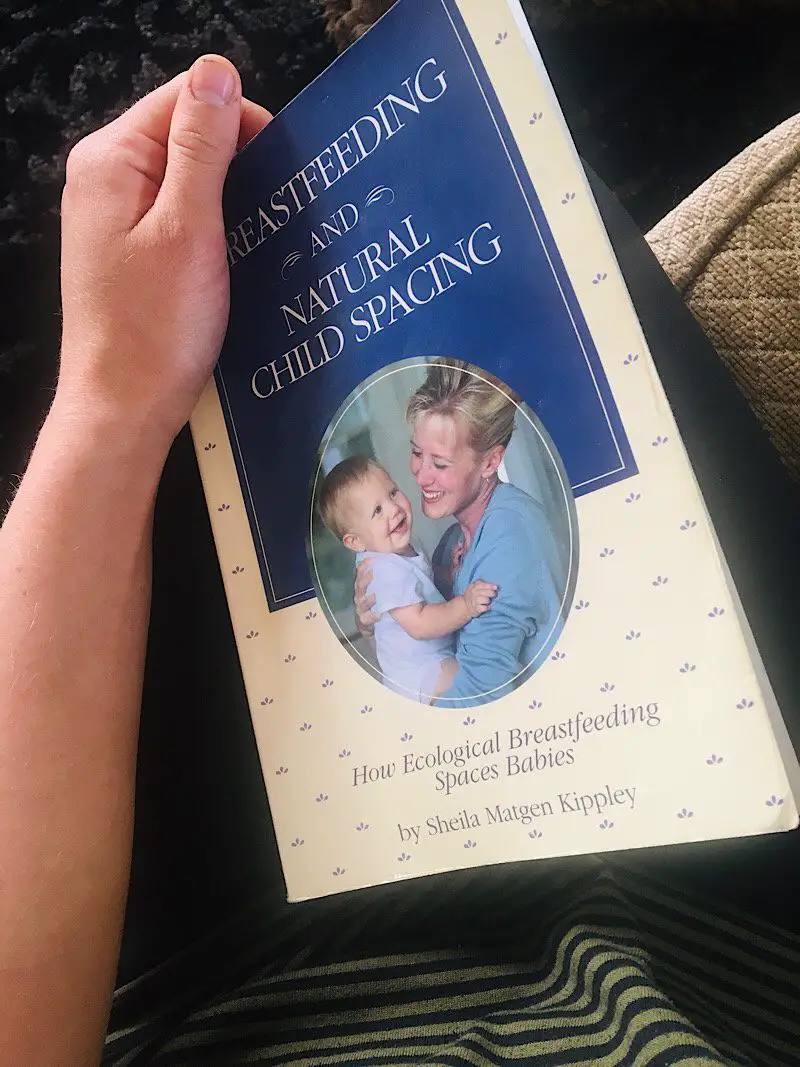
Ecological Breastfeeding is the ‘method’ behind the book “Breastfeeding and Natural Child Spacing” by Sheila Kippley. (Which has become an important book in my parenting library!)
At first glance, ecological breastfeeding seems a little bit overwhelming. The idea that the mother has to meet all (or substiantially most of) the baby’s hunger and comfort needs at the breast seems like a lot to handle. In the beginning, it is. But in the beginning of new motherhood EVERYTHING is too much to handle. No matter how you feed or comfort or sleep your baby, learning new skills means learning new skills. So you might as well knock out a bunch in one go!
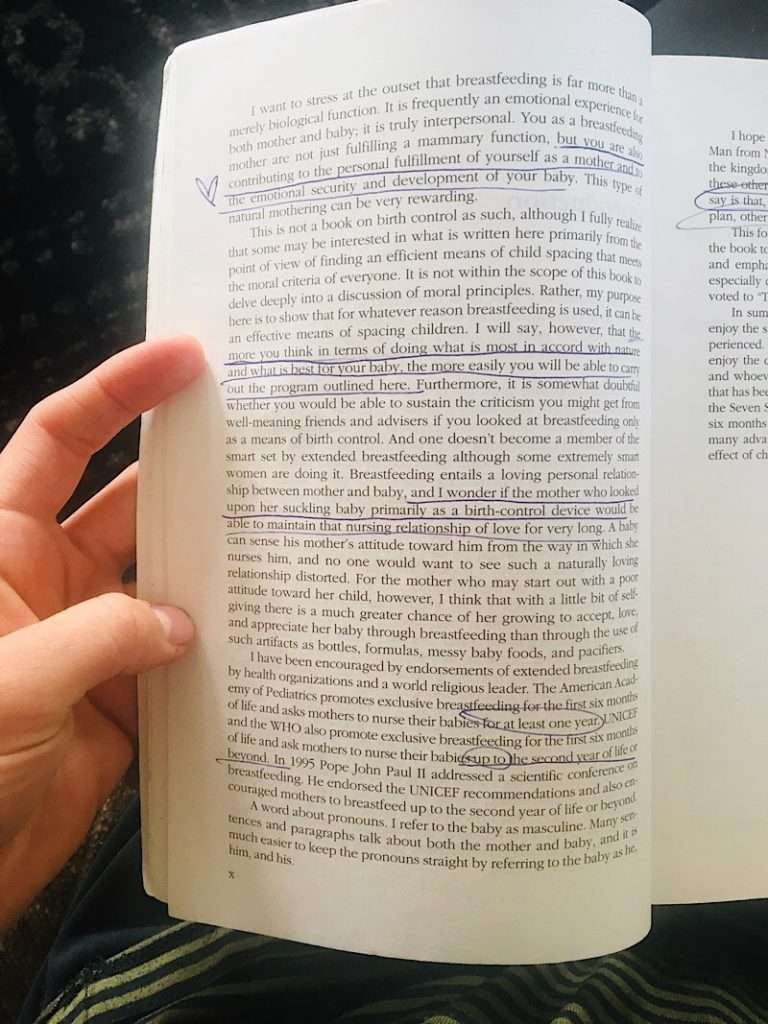
Ecological Breastfeeding really appealed to me. In addition to all the reasons I wanted to breastfeed, ecological breastfeeding offered the following:
- It works in harmony with the baby’s natural inclinations for frequent closeness at all hours of the day
- It forces me to slow down a little bit and have skin-on-skin time with my child, and helps me be more sensitive to my baby’s/toddler’s needs and wants
- ‘Breast-sleeping’ (as Dr. James Mckenna calls it) is the easiest way for me to get more sleep and give my baby more sleep without crying
- You don’t have to deal with bottles or pumping
- It influences the return of fertility and makes child spacing more natural
Benefits I have noticed:
- Less crying at night and in general
- Children are calm and well behaved (they want to stay close to mom)
- No pacifier addiction
- No lovey or blankies to buy or lose
- Less mensural cycles
- Makes fertility awareness easy
Lifestyle considerations I have had to make:
- Some places I used to go where I couldn’t take the baby, I can’t attend as often or I have to wait until they are older
- Learn how to safely Co-sleep
- I am the only one who can feed the baby (except in an emergency of course)
- Baby wants mama for comfort
My Ecological Breastfeeding Story:
To be honest I have no idea how I came across the book “Breastfeeding and Natural Child Spacing” but I am SO glad I did. I probably read about it on someone’s blog, kind of like how I am writing about it now.
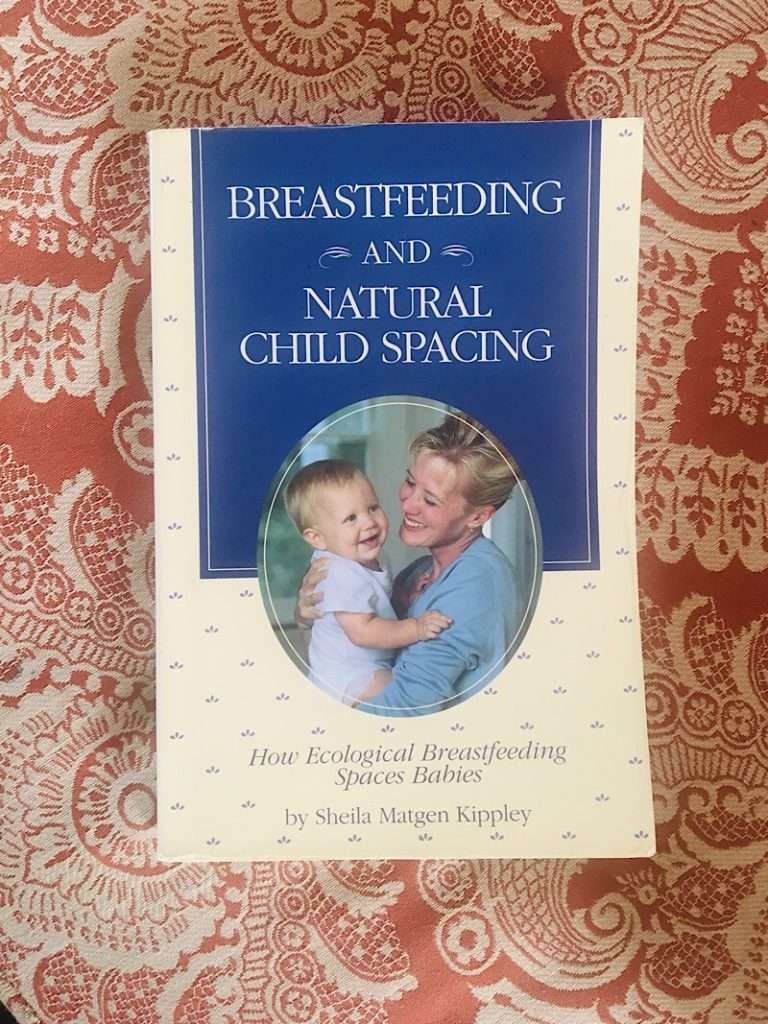
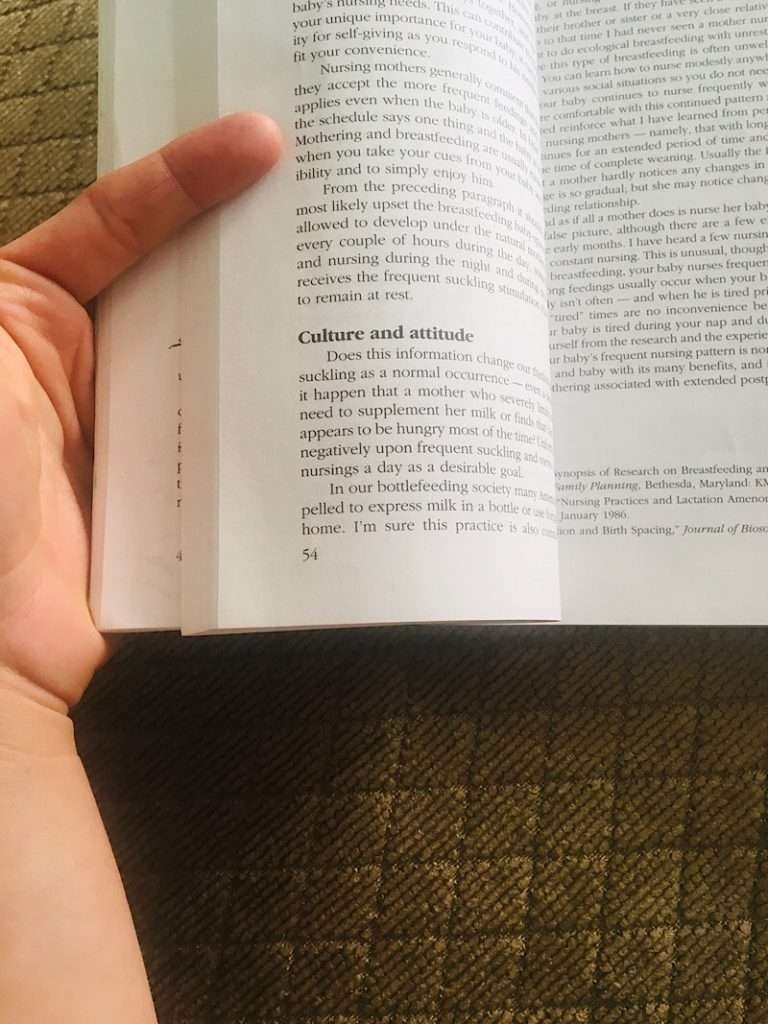
Quickly, I devoured the book as well as her other book, The Frequency Factor. I highlighted it, wrote notes in the margins, and was sold that this was the lifestyle for me.
But I was also a little nervous because it seemed like a huge learning curve, but one that I really wanted to try. I was already jumping head first into cloth diapering, babywearing, and co-sleeping, so why not try this too? (In fact, Ecological Breastfeeding really involves all those other things already!)
For ease in determining if you are ‘nursing enough’ to extend your infertility after birth and achieve natural child spacing, Sheila Kippley outlines 7 recommendations to follow in caring for your nursling:
- Exclusive breastfeeding for the first 6 months
- Pacify your baby at the breast
- Don’t use bottles of pacifiers
- Sleep with the baby for night feedings
- Sleep with the baby for a daily nap feeding
- Nurse frequently, on demand
- Avoid anything that restricts nursing or separates you from your infant, and wean baby at their own pace
To me, the point of ecological breastfeeding is not necessarily to check off a list of rules. The point to the 7 recommendations is to feed and comfort your baby in the way that nature designed for, meaning frequent touching, holding, nursing, and sleeping with the baby.
That’s what babies want, to be close to their mothers. And to be honest, if I slow down a little and stop worrying so much about all the things that don’t matter as much as my baby, that’s what I want too. I just want to be with my baby.
In the beginning while learning the ‘method’, I was quite strict with myself as far as pacifiers and daily naps go. I was not used to those habits yet, and I wanted to learn to read my baby’s cues very well. I also wanted to make sure I was doing everything I could to stay in amenorrhea, as long as that is what my body and the baby wanted.
Sheila provides compelling evidence that when these guidelines are followed, menstruation stays away, and that is what happened for me. Its a win win for mother and baby.
One of the things I remember being slightly stressful and difficult for me to learn was how to manage long outings with the baby such as grocery shopping. I would nurse her before leaving the house, then drive 30 minutes to the grocery store, maybe to nurse again. I would shop, then nurse her in the car before coming home. Then probably nurse again at home.
I was quite worried that she would go too long between feeds that she would starve, or that my fertility would return, or that the universe would explode. In general I was just stressed about a lot as a new first time mom!
(Later with my second child, I learned that this stress was not necessary. In time I was much more willing to go 2-3 hours without a nursing session when I was grocery shopping. I was also more willing to offer the breast and have it be refused instead of worrying that she was not getting enough. In short, I learned to truly feed on demand and trust the process, and trust my baby to tell me when she needed me.)
I stayed close to my baby for the first year of life. I did have one doctor’s appointment that was about 2 hours long that the baby could not accompany me to. That was a little hard for us both. Besides that event, I left my baby for about 1.5 hours with my husband when she was about 8 months old for a wedding, and for about 1 hour when she was 11 months old with her grandparents when I really wanted to go snowboarding. ?
I think both instances of separation were way harder for ME to handle than for the baby! I nursed her before leaving and immediately upon returning and everything was fine. After that point, when my baby was about 18 months old, babysitting events became slightly more frequent, but not much.
I started her on solids when she was ready for them, which was about 6 months of age. It was slow at first, and I did not decrease nursing or replace nursing sessions with solids until much later. I tried to nurse her before meals so that the bulk of her hunger was met at the breast, but I respected her desire for solids and did not withhold them when that is all she wanted to eat.
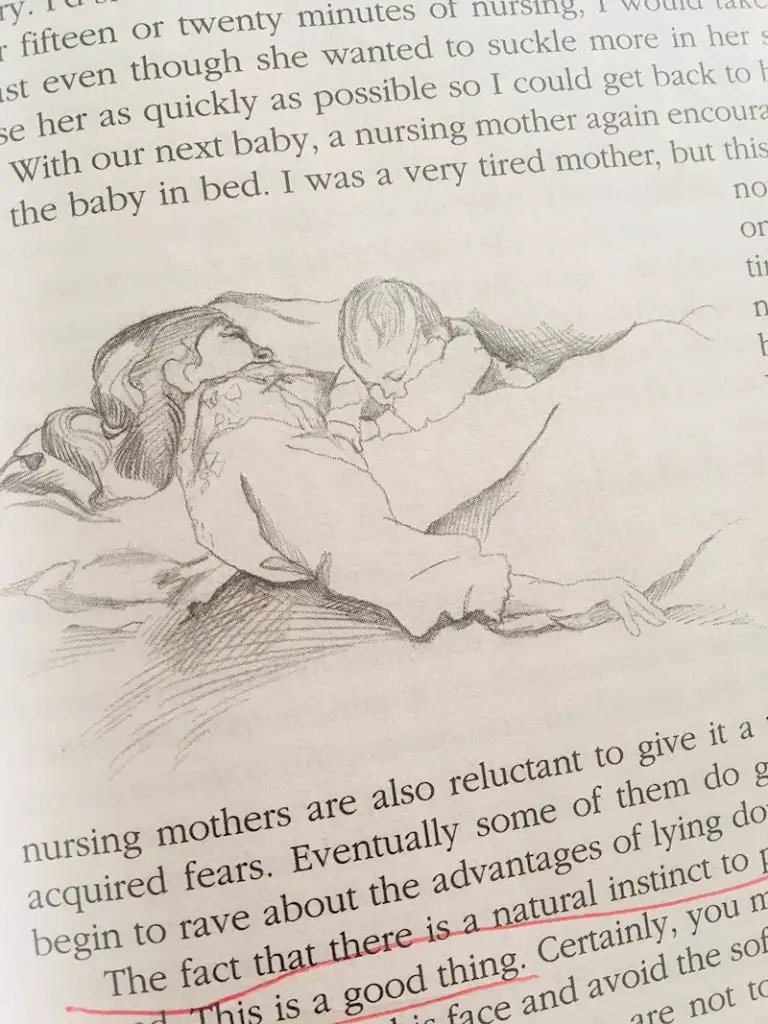
As for night feeds, my first daughter was quite needy at night and often nursed 5-6-7-8 times a night. Most of the time it was not a problem, because I just learned how to sleep through it. This frequent night nursing was difficult but my body seemed to adapt to motherhood’s sleep shortages and we survived. I now realize that each child’s nighttime parenting needs are different. My second child does not night-nurse as frequently as the first child.
Later, when I got pregnant again I developed a nursing aversion and had to arubptly night wean her. It was extremely hard for several days and weeks, but ended up okay as I continued to offer nursing during the day. (She has always struggled with sleep issues and has finally been sleeping quite well now as an almost 4 year old.)
My cycle returned at about 12 months postpartum.
And then skipped a month, and then fully returned. I was both disappointed as well as excited when it returned. I was disappointed because I had hoped that I would be one of those women who made it 20 months without a cycle! But I was also excited that I DID it!
I took my cycle returning as a sign that my body had healed, I had found a great routine, and I was healthy enough to start preparing for another pregnancy. I got pregnant again about 5 months later.
‘Practicing’ ecological breastfeeding with my second child was a little different of an experience. I was not so concerned about my baby needing to nurse quite as often, as mentioned earlier. What I was mostly concerned about nursing her in a way that was both meeting her needs as well as practical for me now that I had two children. I was also already in the habit of babywearing and co-sleeping, which were SO much easier the second time!
The second time around, I was much also more comfortable reading cues, and I had a little bit of an idea what my body would do as far as my cycles returning postpartum. I wasn’t particularly worried about NEVER giving this baby a pacifer, I used them sometimes while grocery shopping or here and there during the day or in the car when I just couldn’t nurse (or if the baby really didn’t want to nurse. I also let her use my pinky to suck on sometimes whilte babywearing.)
This new baby started solids at about 6 months as well. Similar to my first child, I remained physically close to her during the day, and did not have many (or any) baby sitting events. I was slightly more lax in general, but I still met all her feeding needs directly at the breast, as well as most of her comfort needs. She slept much better than my first, but still nursed multiple times during the night.
My cycle returned at 10 months postpartum this time. I attribute this to my lack of following the daily nap rule, and perhaps also the fact that she just nursed slightly less often than the first child (although it was still at least 12+++ times a day for the first several months.)
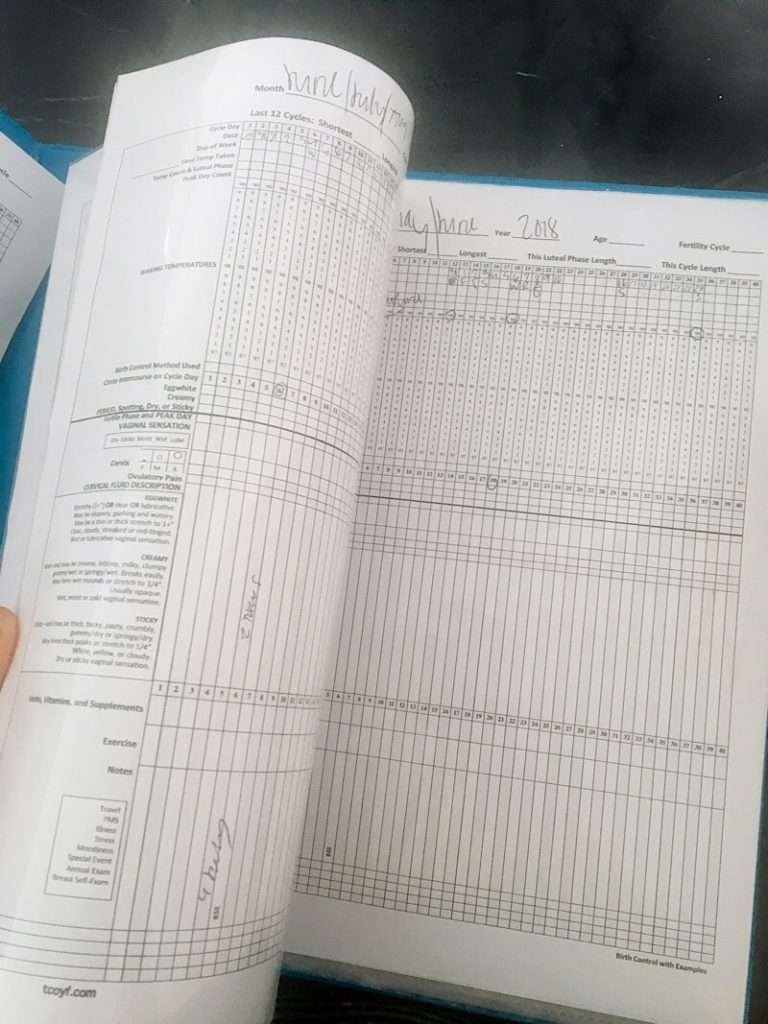
At first I was slightly upset that menstruation had returned earlier than before, but I was so glad to have gotten 10 months at all! I was also much better at charting and fertility awareness, so having a few ‘extra’ cycles to chart through was not a big deal to me. The first several cycles were quite long at 40 days and unusally painful during ovulation. I attribute this to my body ‘remembering’ how to return to normal fertility.
I continued to practice natural family planning without the use of any contraceptives, and here I am typing this at approximately 16 months postpartum, still cosleeping and breastfeeding.
Ecological breastfeeding to me is not a method. It is a lifestyle.
Ecological breastfeeding is more about the relationship and closeness you have to your baby than the checklist, although the checklist helps you determine how frequently you are breastfeeding.
Some babies will learn to sleep longer stretches at earlier or later periods, and some mothers will not have their fertility affected. Some women follow the ‘rules’ to the ‘T’, and still have their cycles return before 9 months (although from her research, this seemed to not be the average response.) It is probably different for every woman and every baby.
Sheila does point out in her book that Ecological breastfeeding is not the same as Exclusive breastfeeding, and that if a woman experiences an unexpected return of fertility there may be a contributing factor such as fatigue to consider, or perhaps that is just nature’s plan for her. But it does seem like nature provided an effective means to child spacing, one that it free and built in!
I like ecological breastfeeding. It works for me. It provides me many benefits and helps me take care of my baby better. I don’t always think nature is right, but this mother-infant relationship seems to work out nicely. Moms need to be needed. Babies need to be held. Its a great pairing.
I have achieved wonderful child spacing following the principles outlined in this book. I have also learned to practice Natural Family Planning and Fertility Awareness, which also help space children naturally.
My recommendation to any mother considering this method is to just read the book and learn about it! You can’t know what parenting choices you want to make unless you know what options there are.
In short, here are some quick questions answered about Ecological Breastfeeding from my point of view:
Does Ecological Breastfeeding really work? Does it actually space babies?
Yes, it does for me. It successfully delayed my fertility from returning for 12 and 10 months postpartum.
Is Ecological Breastfeeding Hard?
Yes and No. It may or may not be difficult to learn to make lifestyle changes or make new parenting choices. It may be difficult to overcome the cultural norms and traditions surrounding breastfeeding in your area/family. I was the first person in my family to successfully breastfeed in this manner, so I didn’t have anyone to teach me. But I was successful and very glad to have put in the work to learn to breastfeed and co-sleep at the beginning, years later is is the most natural and simple thing in the world! It has become almost effortless.
What are some benefits of Ecological Breastfeeding?
My babies cry less, my milk supply is increased, I get better sleep at night, I don’t have to worry about losing a pacifer or cleaning bottles, I grow a strong bond with my infant, and my infertility is suppressed for a year post partum.
Will you ever use any other method of child spacing?
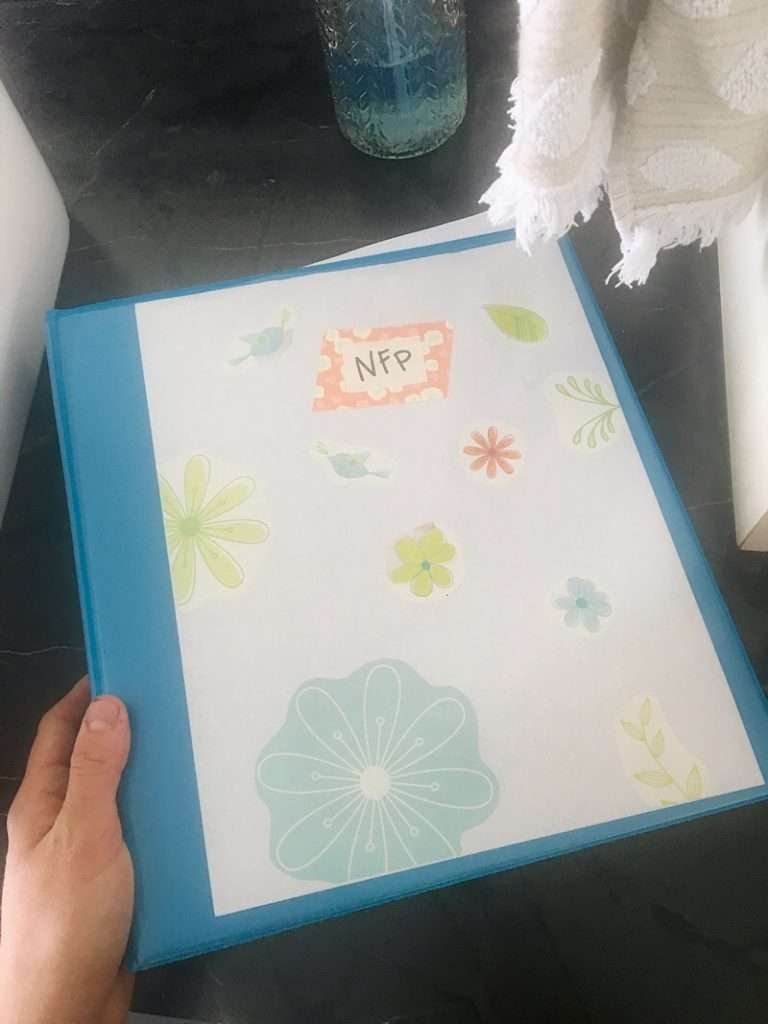
Ecological Breastfeeding paired with Fertility Awareness (specifically Natural Family Planning) works perfectly for me. There is no need for me to ever purchase or use any other form of contraceptive, in fact I never have. I love that I am in almost complete control of my fertility, I don’t rely on any device, doctor, or drug to determine when I can have a child. It is so liberating to just let nature do its thing, and when my cycle returns I practice NFP.
Here is a link to the book: “Breastfeeding and Natural Child Spacing: How Ecological Breastfeeding Spaces Babies” by Sheila Matgen Kippley. I like to shop at Abe Books, buying used books saves money and is an easy way to recycle.
Comment below with your experience or if you decide to read the book!
Related Articles:
- Mastery Takes Time: Learning to Breastfeed As A First Time Mom
- What Even Counts as Natural Parenting?
- 3 Ways to Prepare to Thrive Through The Postpartum Period
Disclaimer: I am not your healthcare provider, and this is NOT health advice. I am just sharing my experiences and opinions, one mom to another. Ask your healthcare provider for specific medical advice.